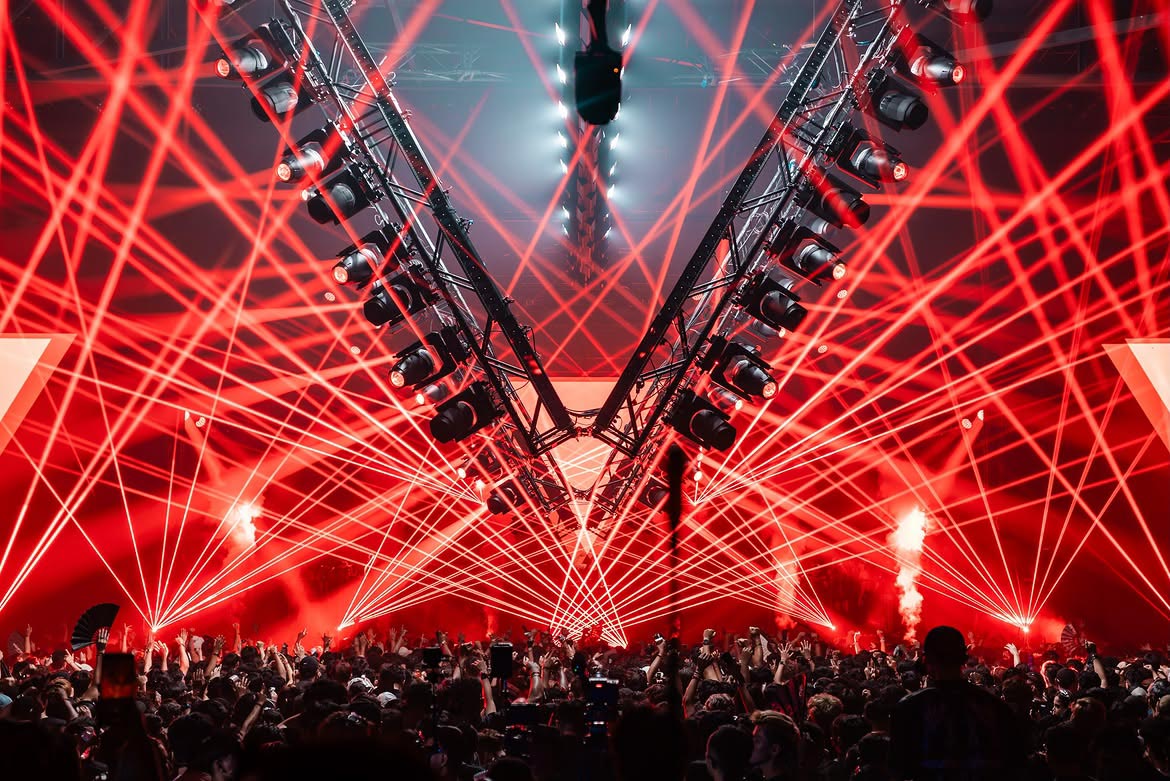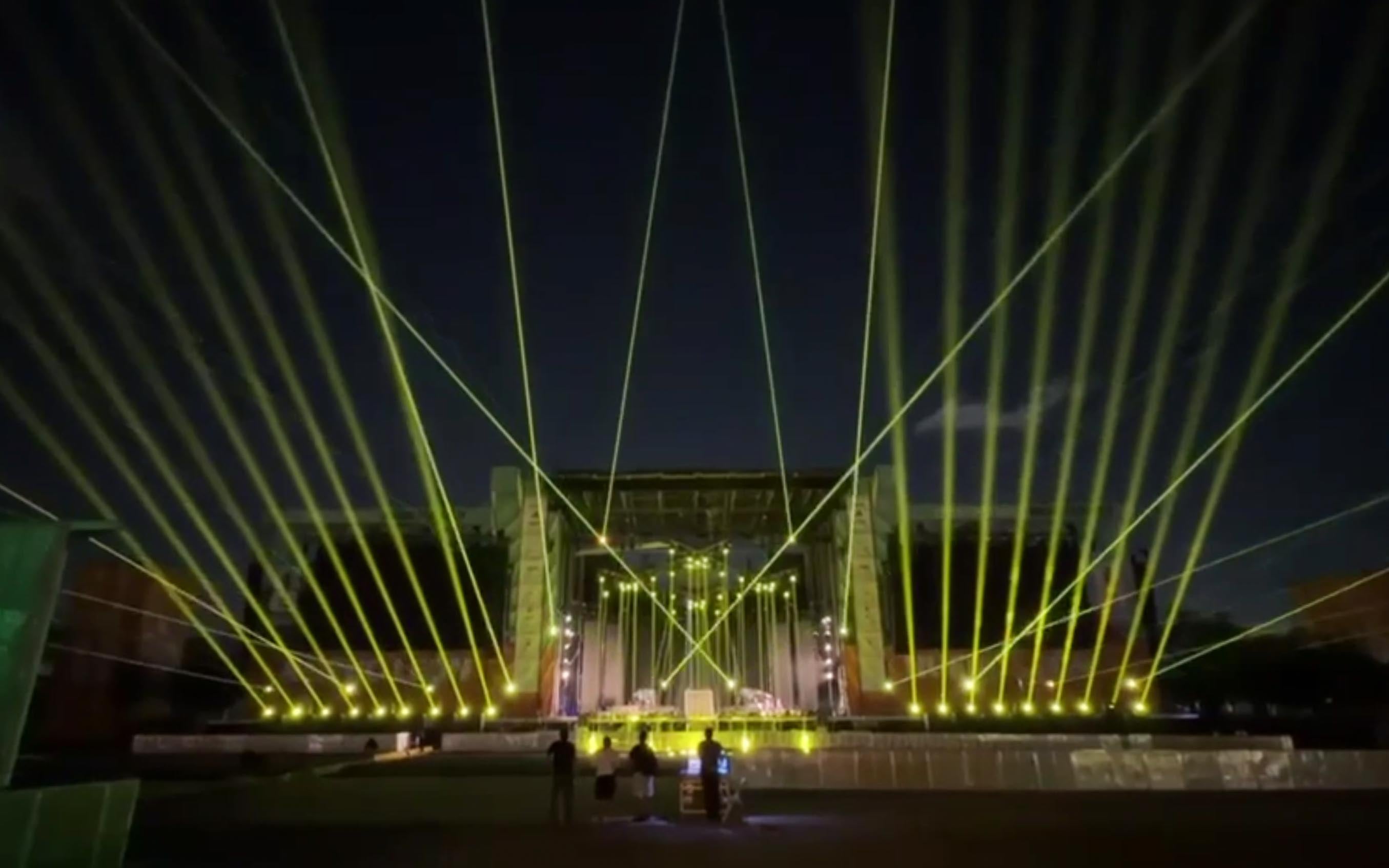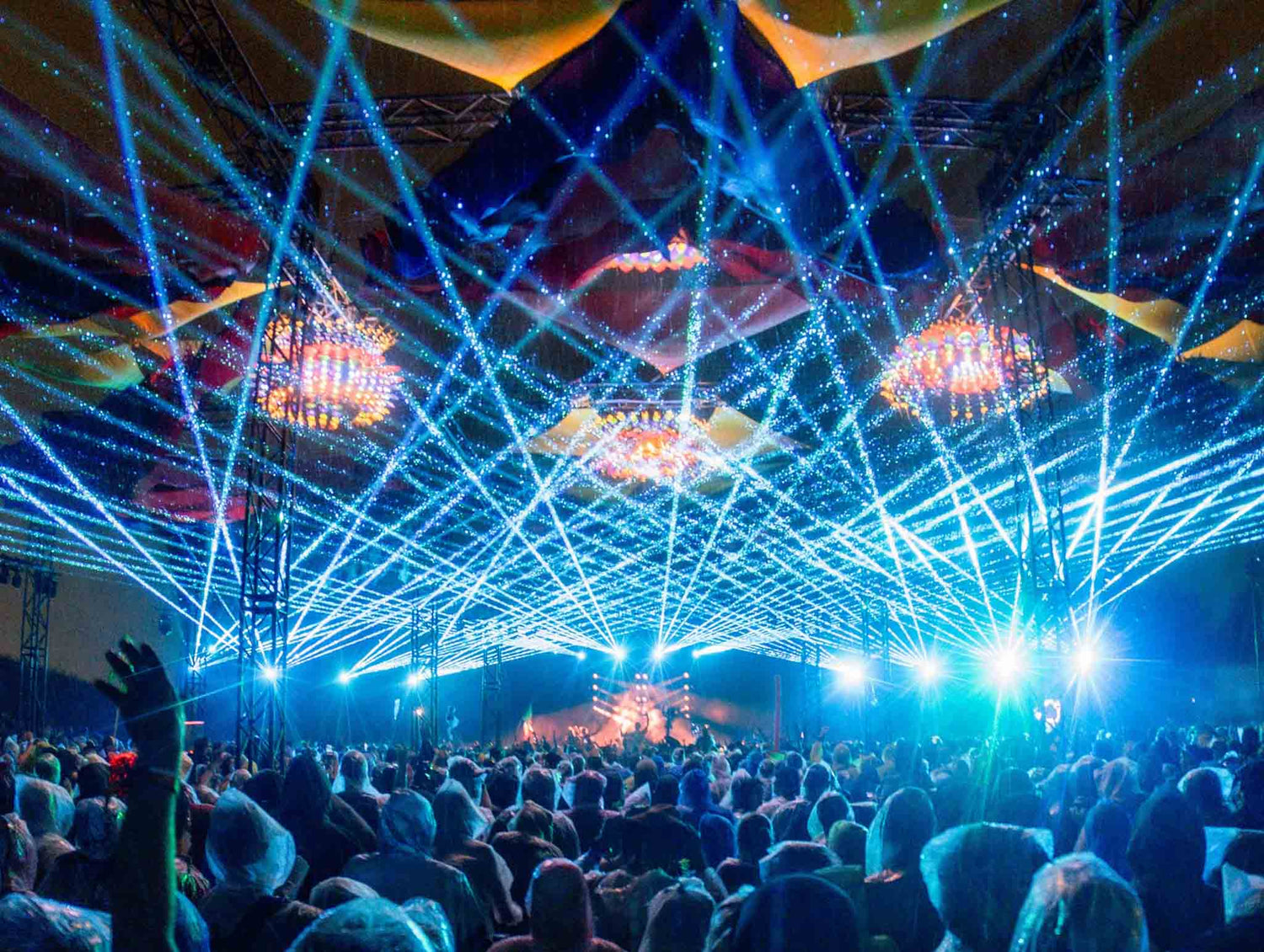
Every summer, VELD Music Festival turns Toronto's Downsview Park into one of the largest electronic music showcases in the country. Across its stages, sound, video, lighting, pyrotechnics, and lasers combine to amplify the energy of each performance.
For this year’s edition, the laser rig featured twelve 40-watt, IP65-rated projectors, each with Pangolin FB4 control hardware built in. DC Lasers handled the design, programming, and live operation, running the complete show from a single workstation on Pangolin BEYOND Advanced.
Without timecode driving the production, every laser cue was triggered live through Pangolin BEYOND, built on instinct and timing rather than a pre-set sequence.
Pre-Production and Designing the Laser Rig
The preparation started in Depence R4, where DC Lasers’ Danny built a virtual version of the complete rig. This allowed him to visualize projector positions, map out projection zones, and refine cues in BEYOND well before the physical system was installed at the festival.
Working in a virtual environment also let him evaluate cues as part of the wider stage picture. Instead of treating each projector as an isolated source, he could design the twelve-projector system as a single visual instrument, with beams moving across multiple zones in coordinated patterns. Once the foundation was in place, each cue was adjusted until its movement, timing, and scale felt right for the venue.
Building Laser Effects Around the Beat
Most of Danny’s programming was based on musical beats rather than fixed durations. To make that work, he carefully calculated zone chases and cue-shift offsets, keeping the movement across the rig synchronized with the rhythm.
By offsetting cues between projectors, a single laser effect could travel across the stage instead of firing everywhere at once. When the timing was calibrated to the beat, those chases became part of the music, building momentum through a phrase and landing clean on the accent. The vertical range within the projection zones also opened up opportunities to move beyond usual horizontal sweeps. DC Lasers developed cues that used the Y-axis to give the beams a pronounced “bouncing” motion, adding another layer of energy and depth to the show.
Preparing for Every Artist’s Visual Identity
Live festival programming often means operating lasers for artists whose music and performance style may be unfamiliar. For DC Lasers, preparation therefore extended beyond building effects.
Before the event, the programmer spent several days listening through the artists’ discographies to understand their sound, pacing, and emotional range. He also reviewed their visual identities and online presence, noting the colors most closely associated with each artist.
That research helped inform the selection of colors, cue styles, and movement across every performance. A euphoric, melodic set could be given a different visual language than a darker, more aggressive one, even though both were being operated from the same rig. The goal was to make the lasers feel built for each artist specifically, shaped around the vibe they were going for rather than the same collection of effects applied to every set.
Less Is More

With twelve high-powered laser projectors on hand, it would have been easy to keep the lasers active throughout every performance. However, DC Lasers adopted a more deliberate approach.
“For busking and live operation, I like to reserve lasers for big moments,” Danny said. “The way I see it, lasers are just seasoning, while the meat and potatoes come from lighting and video.”
That philosophy shaped how the lasers were introduced throughout each set. Instead of competing with other visual departments, they were selectively used to create contrast and give every element of the production room to shine.
“I prefer operating lasers in a way where everyone gets time to shine and showcase their skills. This often means only doing lasers for the first half of the chorus and letting lighting and video have fun in the second half.” The restraint preserved the impact of each laser moment.
Ultimately, the show was built around collaboration more than any one department. “Nothing brings me more joy than when everyone works in harmony,” he added.
Performing the Entire Show Live With BEYOND
The complete laser system was running off of DC Lasers’ workstation using Pangolin BEYOND Advanced.
With no timecode involvement, transition, color choice, and blackout was triggered live. This busking workflow meant reacting to each artist in real time, following the set as it shifted and choosing effects that match the energy in the music and the crowd.
BEYOND Advanced provided the programming and live-control environment for the twelve-projector rig. Projection zones, cue offsets, colors, and effects could be prepared in advance, then performed as a responsive visual instrument during the festival. With Pangolin FB4 hardware built directly into each laser projector, the units could be controlled over a network from the BEYOND workstation, helping simplify communication across the large-scale system.
The combination gave DC Lasers the structure required for detailed preproduction and the flexibility needed for a completely live performance.
A Trusted Production Partnership

The laser systems were supplied by Andrew Hussey of Backliner, a go-to supplier for large-scale laser shows in the Toronto market. DC Lasers and Backliner have worked together successfully for several years, delivering impactful productions at venues throughout Southern Ontario.
That established relationship supported the delivery of a powerful twelve-projector system suited to the demands of a major outdoor music festival.
Show Credits
Laser Supplier: Backliner – Andrew Hussey
Laser Programming and Operation: DC Lasers