Laser light is one of the most fascinating and consequential inventions of the modern era. It scans your groceries, corrects your vision, carries the internet across continents, and when turned toward a sky full of haze and smoke, creates some of the most visually breathtaking moments in live entertainment. But what, exactly, is laser light? And how is it so fundamentally different from the light coming from a lamp or the sun?
At Pangolin Laser Systems, we've spent decades pushing the boundaries of what laser light can do as an art form and entertainment medium. We're uniquely positioned to explain not just the science of laser light, but why that science makes it the most powerful and precise tool in the visual designer's toolkit. This guide covers everything, from the atomic physics behind laser light production to the different types, applications, safety classifications, and how laser light shows are created.
What is Laser Light

The word LASER is actually an acronym. It stands for Light Amplification by Stimulated Emission of Radiation. This six-word phrase captures the entire mechanism behind how a laser device creates its signature beam, but let's unpack it in plain English.
All light, whether from the sun, a candle, a light bulb, or a laser, is made of tiny packets of energy called photons. The difference between laser light and every other type of light comes down to how those photons are organized. In a standard light bulb, photons are emitted randomly, they travel in every direction, at many different frequencies (colors), and completely out of sync with each other. It's organized chaos.
Laser light is the opposite of that. In a laser, photons are generated through a highly controlled chain reaction that forces them to be identical, same direction, same wavelength (color), and perfectly synchronized. The result is a beam of light that doesn't spread, doesn't scatter, and can travel enormous distances while concentrating its energy into an incredibly small point.
How Laser Light Is Produced
Understanding how laser light is produced requires a quick visit to the world of atoms. Don't worry, we'll make it as clear as possible, step by step.
Step 1: Atoms and Their Energy Levels
Every atom in the universe has electrons orbiting its nucleus. These electrons exist at specific, fixed energy levels, think of them like rungs on a ladder. Under normal conditions, electrons sit on the lowest rung they can (called the "ground state"). They're at rest, stable, and content.
Step 2: Pumping Energy In (Excitation)
When you introduce energy into a laser device, from electricity, a bright flash of light, or another energy source, the electrons in the laser's gain medium (the material inside the laser) absorb that energy and jump up to a higher rung on the ladder. They're now in an "excited state." The process of pushing large numbers of electrons into this excited state is called pumping.
Step 3: Population Inversion
For a laser to work, you need more electrons in the excited state than in the ground state, a condition called population inversion. This is like flipping a stadium so that most fans are in the upper seats rather than the lower ones. Without population inversion, photons get absorbed rather than multiplied, and no laser beam is produced.
Step 4: Stimulated Emission - The Chain Reaction
Here's where the magic happens. When a photon passes close to an excited electron, the electron doesn't just spontaneously release its energy, the passing photon stimulates the electron to release its energy as a second photon. Crucially, this second photon is identical to the first: same wavelength (color), same direction, same phase (synchronized timing).
That second photon then travels through the gain medium and stimulates two more electrons to release two more identical photons. Those four photons stimulate four more, which stimulate eight, and so on. It's an exponential chain reaction of perfect, synchronized light.
Step 5: Amplification With Mirrors (The Optical Cavity)
The growing beam of photons is bounced back and forth between two mirrors at either end of the gain medium, this mirror assembly is called the optical resonator or optical cavity. With each pass through the gain medium, the beam grows more powerful as more excited electrons are stimulated to release photons. One of the mirrors is slightly transparent (the "output coupler"), allowing a fraction of the amplified beam to escape, and that escaping light is the laser beam you see.
Key Parts of a Laser Device
Whether you're looking at a tiny laser diode the size of a grain of sand or a massive professional laser show projector, every laser shares the same core components.
Gain Medium
The material where stimulated emission occurs. It can be a gas (like argon), a crystal (like ruby or Nd:YAG), or a semiconductor diode. The gain medium determines the laser's wavelength (color). Modern professional show lasers use diode laser technology for its reliability, longevity, and efficiency.
Energy Source (Pump)
Provides the energy needed to excite electrons into the excited state (population inversion). This is typically an electric current in diode lasers, or intense flashes of light in older designs like the ruby laser.
Optical Resonator (Mirrors)
Two mirrors, one fully reflective, one partially transparent, surround the gain medium. Light bounces back and forth between them, passing through the gain medium repeatedly to build up in power and coherence until it exits through the partial mirror as a laser beam.
Output Coupler
The partially transparent mirror that lets a portion of the amplified light escape as the final laser beam. The ratio of reflectivity is precisely calibrated for each laser type to optimize beam power and coherence.
The Three Unique Properties of Laser Light
What makes laser light so different from every other light source in the world can be distilled into three fundamental properties. These three qualities are why lasers can do things that no flashlight, LED, or the sun itself could ever accomplish.
Coherent
All light waves in a laser beam travel perfectly in sync, their peaks and troughs line up exactly. This "coherence" is what gives the beam its "speckle" and structure. Think of it as thousands of waves on the ocean all merging into one giant, unified wave.
Directional
A laser beam stays incredibly narrow and focused over vast distances. A regular flashlight spreads into a large cone within a few feet. A laser can travel miles, even to the moon, while remaining essentially the same width. This collimation is what makes laser beams so precise and controllable.
Monochromatic
Laser light is (typically) a single, pure wavelength, a single, precise color. Regular white light is a mixture of all visible wavelengths combined. A red laser at 650nm doesn't contain a single photon of any other wavelength. This spectral purity makes lasers perfect for color-critical applications, from scientific measurement to creating vivid, saturated visuals in entertainment.
Types of Laser Light
Not all laser light is the same. Lasers are categorized by their gain medium, the material that does the amplifying, and this determines the wavelength, power, and best applications for each type.
Gas Lasers
Gas lasers use a mixture of gases as their gain medium. The most historically significant in entertainment is the Argon-ion laser, which produces vivid blue and green beams, and was the backbone of professional laser light shows throughout the 1970s, '80s, and '90s. Gas lasers were powerful and produced beautiful, pure colors, but they were also physically enormous, consumed huge amounts of electricity, generated significant heat, and required extensive maintenance. Today, they have been largely replaced by more efficient technologies.
DPSS Lasers (Diode-Pumped Solid State)
DPSS lasers use a high-powered infrared laser diode to pump energy into a crystal (such as Nd:YAG or Nd:YVO4), which then produces laser light at specific wavelengths. For many years, DPSS was the technology behind the vivid green (532nm) lasers that became iconic in professional shows. DPSS lasers offer good beam quality and color purity, though they can be sensitive to temperature changes and tend to be less efficient than the latest generation of diode lasers.
Diode Lasers - The Modern Standard
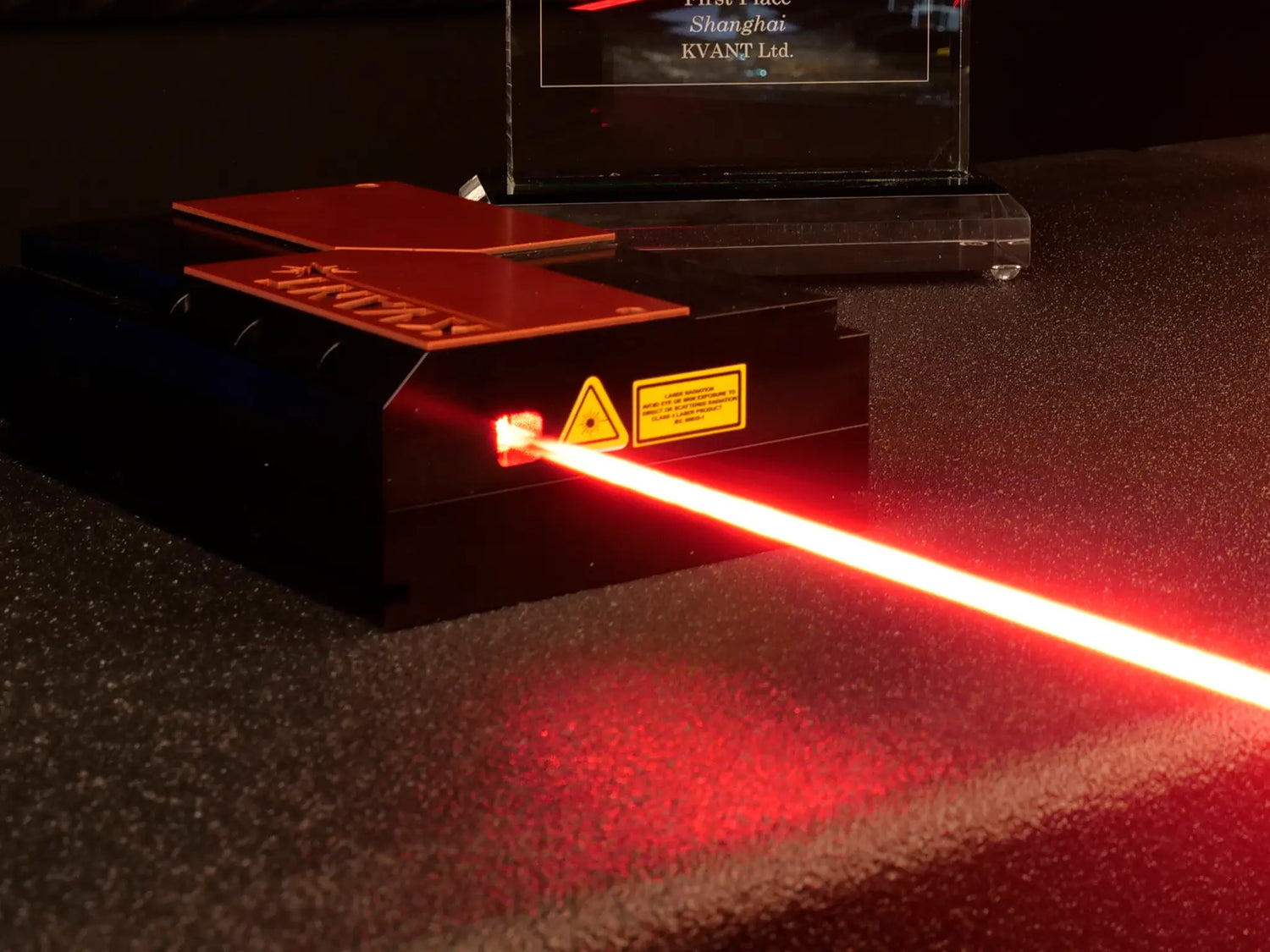
Diode lasers are now the dominant technology in professional entertainment laser systems, and for excellent reason. In a diode laser, an electrical current is applied directly to a semiconductor material, which emits laser light efficiently and reliably. Diode lasers are compact, long-lasting, highly efficient, and can be produced across a wide range of wavelengths. The laser show industry, including the professional-grade systems manufactured by KVANT and distributed through Pangolin — runs on advanced diode laser technology today.
Other Notable Laser Types
Beyond the entertainment world, many other laser types exist for specialized applications: CO₂ lasers (used in industrial cutting and engraving, operating at infrared wavelengths invisible to the human eye), excimer lasers (used in LASIK eye surgery), fiber lasers (used in telecommunications and high-precision manufacturing), and dye lasers (tunable-wavelength lasers used in scientific research), among others.
Emission Modes: Pulsed vs Continious
Beyond the type of gain medium, lasers are also categorized by how they deliver their energy over time, known as the laser's emission mode. This dimension of laser technology has a meaningful impact on both real-world applications and safety.
Pulsed Lasers fire light in extremely short, discrete bursts, sometimes lasting only nanoseconds or picoseconds. The key advantage is that these bursts can achieve enormous peak power for a fraction of a second, without generating the sustained heat that would otherwise damage the laser or the material it's working on. This makes pulsed lasers ideal for precision applications like laser eye surgery, material engraving, and scientific measurement. It's worth noting, however, that pulsed lasers are inherently more hazardous than their continuous-wave counterparts, precisely because of those extreme peak power levels, even when their average power output appears modest on paper.
Continuous Wave (CW) Lasers emit a steady, uninterrupted beam for as long as they are powered. Output remains constant over time, making CW lasers highly predictable and easy to control. This is the standard emission mode for the vast majority of modern entertainment laser systems. The stable, consistent beam of a CW laser is what makes the fluid movement of beams, fans, and graphics in a laser show so visually smooth and responsive to control.
The Science of Color: Wavelength
The color of a laser is determined entirely by its wavelength, which is the direct result of the specific energy transition happening within the gain medium. When an electron drops from an excited state to a ground state , the distance it falls determines the energy of the photon. The bigger the energy gap, the shorter the wavelength.
In the visible spectrum:
- Short wavelengths (around 400nm - 450nm) appear Violet or Blue.
- Medium wavelengths (around 520nm - 550nm) appear Green.
- Long wavelengths (around 630nm - 700nm) appear Red.

If the energy gap in the gain medium is too small or too large for the human eye to detect, the laser produces invisible light. If the gap is massive, it produces Ultraviolet (or UV light); if the gap is small it produces Infrared (or IR light).
Uses & Applications of Laser Light
Laser light has permeated virtually every corner of modern life. Its unique properties, coherence, directionality, and monochromaticity, make it the tool of choice for applications that demand precision, power, or both.
- Medicine & Surgery
- Manufacturing & Industrial
- Telecommunications & The Internet
- Science & Research
- Consumer Electronics
- Entertainment & Visual Art
Laser Light Shows - Bringing It All Together
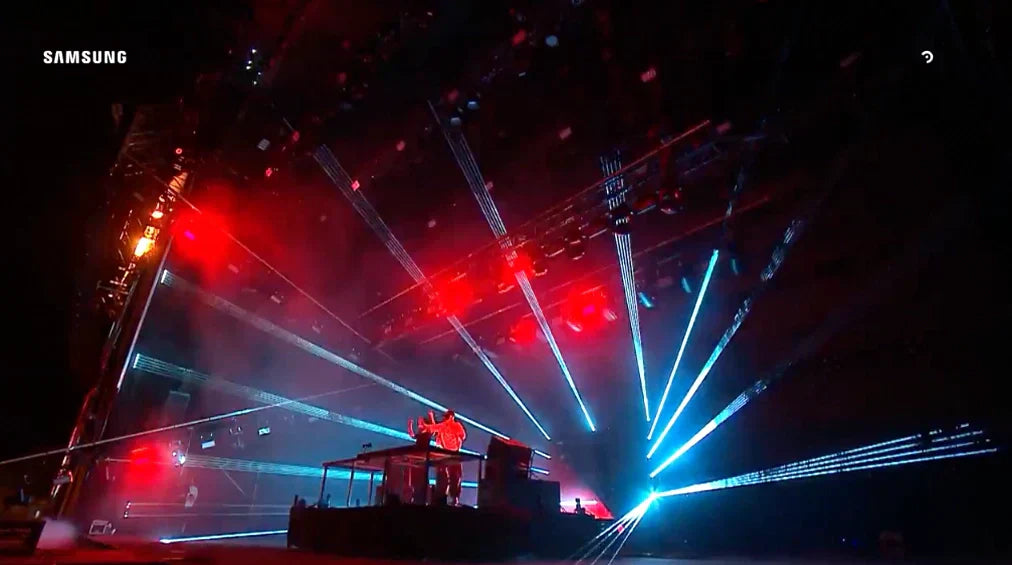
Of all the applications of laser light, few are as visceral and emotionally powerful as the laser light show. When you're standing in a dark arena and the first beam of cyan light cuts through a thick cloud of haze, you're experiencing the culmination of over six decades of physics, engineering, and artistic vision.
How a Laser Light Show Works
A professional laser light show projector is typically built around multiple laser diode modules (typically red, green, and blue) whose beams are combined using precision optics into a single RGB beam. That beam is then directed by a pair of small, incredibly fast mirrors called galvanometer scanners (or "galvos"). These mirrors oscillate at thousands of times per second, steering the beam with extraordinary precision to "draw" shapes, text, animations, and graphic imagery in the air or on surfaces.
The projector is controlled by software and hardware. Pangolin's BEYOND and QuickShow software platforms (used by professional laser artists worldwide) allow operators to program complex shows, synchronize lasers to music, control beam effects in real time, and manage safety parameters across entire arrays of projectors simultaneously. The hardware bridge between the software and the laser projector is typically Pangolin's FB4 network controller, which integrates inside the projector and enables control via PC, DMX, ArtNet, or standalone auto-mode playback.
If you want to learn more about laser light show projectors check out our more in-depth blog post here: https://pangolin.com/blogs/news/what-is-a-laser-light-show-projector
Types of Laser Light Show Effects
The creative vocabulary of a laser light show is rich and varied. Professional laser artists work with a defined set of effect types, often combining several within a single show:
- Aerial Beam Effects & Laser Fans
- Liquid Sky Effects
- Laser Graphics, Text & Animations
- Architectural Laser Mapping
- Interactive Laser Shows
Explore more about the different types of laser light shows here: https://pangolin.com/blogs/news/types-of-laser-shows
Laser Light Safety & Classifications
Laser light is so incredibly versatile and powerful, and with that power comes, of course, a great deal of responsibility. Because laser light is so concentrated, it can pose risks to human eyesight, cameras, and become a fire hazard if not handled correctly. Professional projectors (like ours) must meet strict “variance” regulations (in the US) and international safety standards.
Using hardware that complies with these standards isn’t just a recommendation– it’s a legal requirement for any public show. At Pangolin, we don’t just follow these standards, we are always looking to find ways to make laser light show projectors even safer, ensuring that you can push the boundaries of creativity without compromising the well-being of your audience.
This commitment to safety and creativity is the foundation of our entire ecosystem. When you choose a Pangolin product, you aren’t just buying a laser; you are investing in the industry standard for reliability and creativity.
Laser Safety Classes
Lasers are classified based on their potential to cause injury. In the United States, the FDA uses Classes I through IV (with subclasses). Internationally, the IEC standard IEC 60825-1 uses a parallel but slightly different system with classes 1 through 4. Here is a simplified breakdown for visible-beam lasers:
Class I
- Power Range: Negligible
- Hazard Level & Examples: Safe under all normal conditions. CD/DVD players, laser printers, barcode scanners. Beam is fully enclosed or too weak to cause injury.
Class II
- Power Range: < 1 mW
- Hazard Level & Examples: Low-power visible lasers. The natural blink reflex protects eyes in momentary exposure. Standard laser pointers used in presentations.
Class IIIa
- Power Range: 1–5 mW
- Hazard Level & Examples: Generally safe with normal precaution. Higher-powered laser pointers. Risk increases with prolonged staring directly into the beam.
Class IIIb
- Power Range: 5–500 mW
- Hazard Level & Examples: Potentially hazardous from direct beam viewing. Requires training and eye protection. Used in scientific instruments, some laser show systems.
Class IV
- Power Range: > 500 mW
- Hazard Level & Examples: High-power lasers capable of burning skin and causing immediate, permanent eye damage. Industrial lasers, high-power show lasers. Requires trained, certified operators and strict safety protocols.
Laser Show Safety & Regulation
Professional entertainment laser shows, the kind that use Class IIIb and Class IV laser projectors are regulated by the FDA in the United States and by equivalent regulatory bodies internationally. Producers of laser light shows are required to notify the FDA of planned shows, allowing for potential inspection. In Europe and most other regions, compliance with IEC 60825-1 is the governing standard.
Responsible laser show operators, and the manufacturers who supply them, take safety seriously at every level. At Pangolin, all professional laser systems are designed with built-in safety features including power limiting, emergency shutoffs, and interlock systems, and geometric safety zones that prevent the beam from entering restricted areas. Pangolin's BEYOND software platform includes advanced safety management tools that make it easier for operators to maintain safe exposure levels even in complex, multi-projector environments.
The Bottom Line
Laser light is one of the most remarkable phenomena in modern physics — and one of the most powerful tools humanity has ever created. Its three defining properties (coherence, monochromaticity, and directionality) give it capabilities that no other light source can match: the precision to reshape a human eye, the power to cut through steel, the speed to carry global internet traffic, and the beauty to stop a stadium crowd in its tracks.
At its heart, every laser beam, from the tiny dot of a laser pointer to the 4,000-watt beam wall of a world-record festival show, is the same chain reaction: atoms stimulated to release perfectly synchronized photons, amplified by mirrors, and released as one of the most extraordinary things the physical world can produce.
We hope this guide has given you a solid, lasting understanding of what laser light is, how it works, and why it occupies such an important place in science, technology, and art. If you're curious about bringing laser light into your events, venues, or creative practice, we'd love to help.