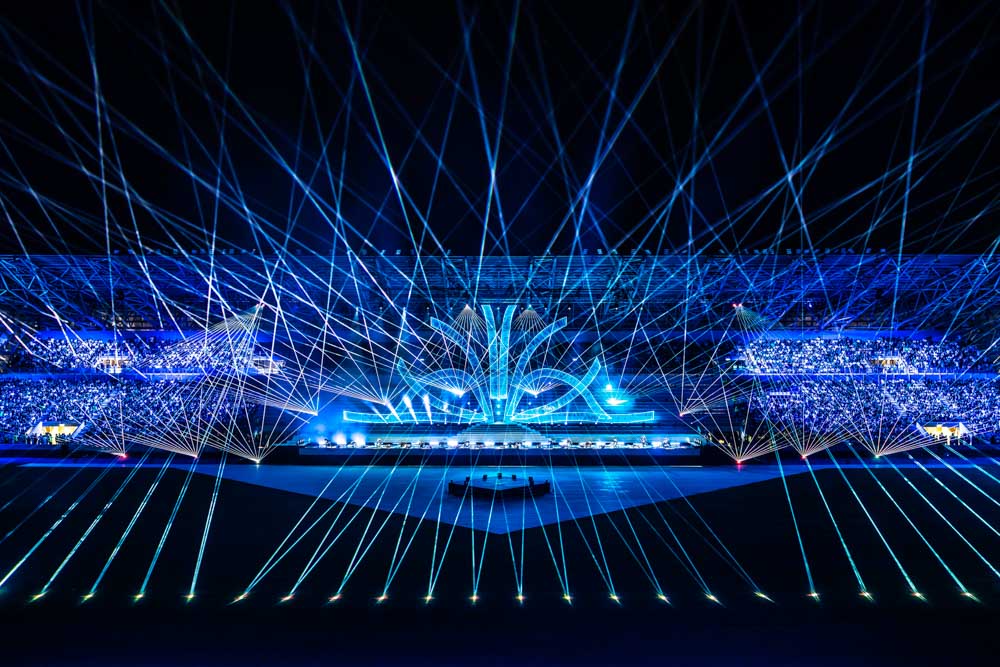
The Opening and Closing Ceremonies of the XX Mediterranean Games called for more than spectacle. The goal was to integrate laser technology as a true part of the show’s visual storytelling, combining laser mapping, beam shows, and volumetric effects across the entire surface of Stadio Erasmo Iacovone.
Bringing that vision to life required 28 high-powered laser projectors, a stadium-wide network, more than 80 projection zones, and a control architecture built around Pangolin BEYOND and FB4.
Designing Lasers as Part of the Story
From the beginning, the objective was to make lasers part of the ceremonies’ visual language rather than use them solely for standalone effects.
The laser concept, design, and technical planning of the system were developed entirely in-house by LSR Labs, with Matteo D’Addio and Andrea D’ambra responsible for the laser design and layout study. In collaboration with the ceremonies’ director of photography, Daniele Davino and Artistic Director Angelo Bonello, they integrated laser mapping, aerial beams, and volumetric compositions with the wider production.
The resulting design placed projectors throughout the stadium:
- Ten projectors were installed on the truss above front of house, primarily for field mapping.
- Six projectors were positioned on the stage truss for mapping and volumetric effects.
- Twelve ground-mounted projectors created large-scale beam looks across the stadium.
By working simultaneously from above and below, the team could create three-dimensional compositions that filled the venue’s full visual volume. Beams could rise from the field as others descended from the stadium structure, surrounding performers and scenic elements with coordinated layers of light.
Mapping an Entire Stadium Field
One of the production’s greatest technical challenges was mapping the full playing surface.

A defining moment during the Opening Ceremony featured a large map of the Mediterranean projected across the field. Rather than originating from a single source, the image was divided among multiple laser projectors working together as one coordinated graphic system.
The visual content was created through a dedicated graphics workflow before being adapted and programmed inside BEYOND. The field-mapping sequence alone required 48 projection zones organized across Main and Backup layers.
Once the graphic, volumetric, and safety requirements were included, the complete BEYOND project contained more than 80 zones.
Projector placement required particular care because the lasers shared truss positions with the lighting department. Each position had to achieve the required projection geometry while preserving the flexibility needed for a fully redundant Main and Backup system.
Pangolin BEYOND at the Center of the Production

All laser programming was created by Matteo D’Addio using Pangolin BEYOND.
“The most interesting challenge was fully integrating laser technology into the narrative of a ceremony of this scale.” Said Matteo. “With 28 projectors, more than 80 zones, and a Main/Backup architecture built around BEYOND and FB4, we needed to maintain creative freedom, precision, and reliability at the same time.”
BEYOND acted as the central environment for adapting graphic content, defining projection zones, programming beam and volumetric effects, and controlling the complete laser system.
The ceremonies combined two different operating approaches. Precisely structured sequences ran through timecode, while other portions were performed live in busking mode. Timecode was distributed through Visual Productions’ TimeCore.
For live control, a grandMA3 console connected to BEYOND through the DMX Server. LSR Labs developed a custom control profile specifically for the production, allowing the laser operator to execute live looks while keeping the system connected to the wider show-control workflow.
This combination gave the team the precision required for tightly synchronized ceremonial sequences and the flexibility needed for live performance moments.
Building Automatic Redundancy with BEYOND
Reliability was a fundamental requirement for a production of this scale. LSR Labs therefore built the system around two independent BEYOND workstations configured as Main and Backup.
Using PangoScript and BEYOND UDP communication, the team developed a custom automatic failover system. Each workstation continuously monitored the other’s presence on the network. If the Main workstation stopped responding, the Backup system was configured to assume control of the FB4-equipped projectors automatically.
This architecture helped eliminate a critical single point of failure without sacrificing creative control. The programming team could work with a complex project containing more than 80 zones while maintaining a system designed to continue operating if the primary control workstation encountered a problem.
BEYOND provided the creative environment, but it also became an important part of the production’s operational resilience.
Networking and Previsualization
The production network was designed by Andrea D’Ambra using Luminex GigaCore infrastructure monitored through Araneo.
FOH and the stage were connected through two 300-meter Quadcon fiber lines. The network carried laser, timecode, lighting, and scenic-lighting data, with Main and Backup paths designed to reduce single points of failure.
Before installation, the team also completed nine days of previsualization in Depence. Lasers, lighting, scenic elements, effects, and performer movements were programmed together, allowing the onsite period to focus on alignment, geometric correction, and final optimization.
Spotlight on LSR Labs
LSR Labs was responsible for the laser system, creative design, technical infrastructure, programming, networking, and live operation.
The Italian company specializes in laser shows and high-impact special effects, combining creative development with custom technical solutions.
For LSR Labs, this integration was the most interesting part of the project: using a technology normally associated with concerts and large festivals inside an international ceremony, making it part of the storytelling rather than simply a spectacular effect.
Production Credits
Laser system and technical infrastructure: LSR Labs
Production Company: G2 Eventi – Castadiva Group
Laser designer, operator, programming and LSO: Matteo D’Addio
Laser supervisor and network-system design: Andrea D’Ambra
Director of photography: Daniele Davino
Artistic Director: Angelo Bonello
Laser control: Pangolin BEYOND 5.5 and FB4
Network: Luminex GigaCore and Araneo
Previsualization: Depence