While the FDA defines laser light shows as “…laser projection systems [that] are used with other optical equipment … for entertainment purposes”, that clinical definition hardly encapsulates the magic.
To us, lasers are more than just equipment– they are a medium. They are a way to bend, form, and shape light to transform any physical space into an immersive art installation. We achieve this transformation through a few primary methods: Aerial effects, Graphic effects, Laser Mapping and Architectural Laser Lighting, and Interactive Laser Shows
Laser Beam and Aerial Effects
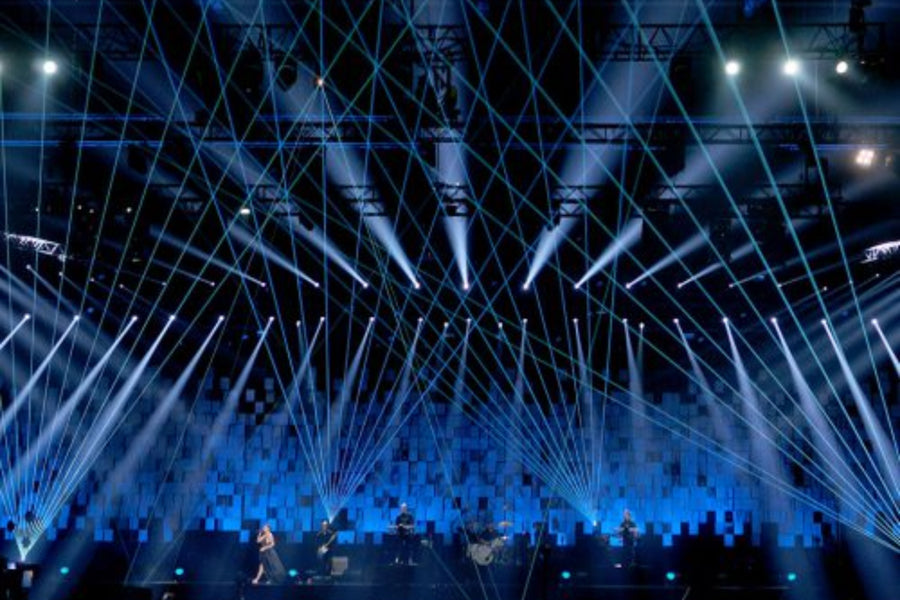
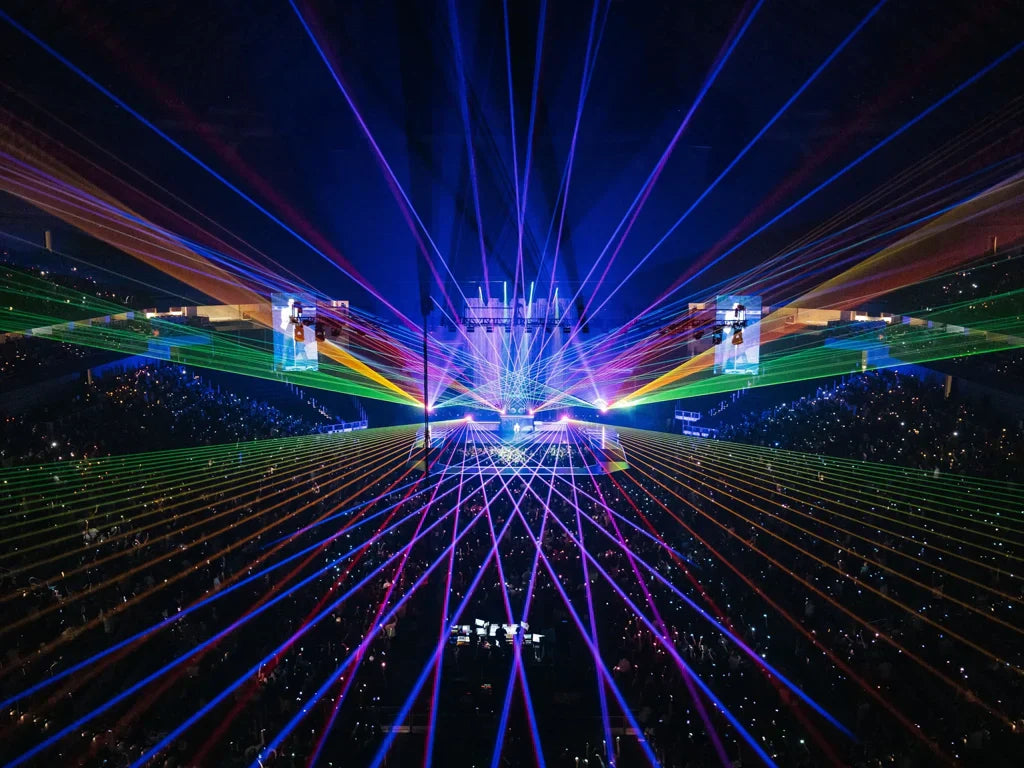
With Aerial Effects, the laser projector scans – repeatedly tracing a path at a speed imperceivable to the human eye – to create beams, fans, and “tunnels” of light. When these beams cut through haze or fog, they create a solid-looking ceiling of light right above the audience’s heads. Aerial laser shows are considered one of the most common types of laser lighting displays that are created. These types of effects are typically synchronized with music or some other event, in order to add additional impact and energy.
Aerial shows are typically programmed using a variety of shapes and patterns within laser show software (such as Pangolin's QuickShow or BEYOND software). Using the powerful tools within the laser show software, users are able to create, modify, and project a virtually endless stream of incredible laser beam shows and effects.
There are a few different type of aerial shows, these include laser fans, hot beams, sheets, tunnels, liquid sky effects, and audience scanning effects. You can see examples of each these laser effects below.
To see a video of these effects, check out our video on Forbidden Kingdom 2026!
Hot Beam Effects
Hot beam effects, as pictured here, are a single or array of tight beams that look like a single line cutting across the sky. The reason we call them hot beams is due to their high power concentration. Since all of the laser’s power is focused down into one spot, this effect is much hotter and potentially damaging if kept in one spot. This is why we generally advise to keep hot beam effects moving at all times.

Tunnels, Fans, & Sheets
Tunnel, fan, & sheet effects are often difficult to differentiate in photos, but in person they give vastly different effects as they move.
Tunnel effects are exactly like they sound, they are a tunnel of light. If looked at on a wall, they would be a circle or oval.
Fans, when looked at on a wall, look like a series of short lines moving around in space, but in the air, it can give a fun and dynamic visual illusion similar to when a cartoon character turns to the side and becomes flat.
Sheets are similar to fans, but are much wider, and generally don’t spin on their X axis. With sheet effects we can create a false ceiling with light, raising and lowering it to change the feeling of the space. Sheets are also the effect where it is easiest to see the Liquid Sky effect.

Liquid Sky
Liquid Sky is the effect that happens when you can see fog or haze swirling in an aerial effect. This is an effect we strive to achieve in almost every aerial show, and part of why having atmosphere in the air is so crucial to an aerial laser show. (The other reason haze is crucial is due to the beams being less visible in non-atmospheric air.)

Audience Scanning
What some may consider the "holy grail" of laser effects, Audience Scanning is the act of intentionally projecting laser light into the audience, allowing the audience to actively interact with the laser light.
An audience scanning laser system is a certified laser show projector that can legally and safety perform audience scanning laser shows. In the United States, for a laser projector to become audience scanning certified it will need Pangolin's PASS hardware installed. (PASS is the only FDA approved audience scanning safety system in the United States.)
To safely and legally perform audience scanning laser shows there are several rules and steps you must follow to ensure your show is compliant. While we agree that audience scanning is very beautiful, if not done right, it can also be very dangerous. Beams must NOT be on anyone unless special safety measures and procedures are used. In the U.S., the FDA must approve an “audience scanning” variance. Without an audience scanning variance, any audience exposure is likely to be very hazardous and will be illegal.
This article will not be covering audience scanning in-depth since this effect requires a deep knowledge of laser safety. If you're interested in creating your own audience scanning laser shows, get in touch with us by emailing support@pangolin.com.

To see a video example of audience scanning, check out our video from LDI 2021 below!
Laser Graphic Effects
With graphic effects, the laser can act as a high-contrast projector to display logos, text, and complex animations.
Laser graphics and abstract effects are a very fun and popular effect used by many to bring their designs to life in laser. Whether you want to project your company's logo bright and bold for the world to see, or project the names of a newlywed couple overhead during their wedding, the potential possibilities are endless.
Graphics Images
Graphics are exactly as they sound: they are graphic images and designs that can be projected onto a flat surface. These can be static or animated, and can add a fun extra layer to your laser shows.

Laser Text
You can make text with laser as well, like messages, acknowledgements, and names. You can see here in this example that they are projecting a date onto a building. This effect is exceedingly versatile and has been used for anything from awards ceremonies and corporate events to projecting the names of athletes as they come onto field.

Logos & Projections
Advertising and digital signage is one of the many popular ways that lasers are being used, and with the advancements in laser light show industry throughout the years, show laser systems have become more than capable of providing an excellent platform for users to create and spread messages for advertising and digital signage applications.

Here is another example of digital signage:
Abstracts
Like the other Graphics, Abstracts are designs that you project onto a surface, but unlike the others it doesn't form a distinct image. Instead it is a collection of abstract (hence the name) shapes, lines, and colors both still and animated.

3D Animations
3D Animations are best visualized in video, so I have included a link here as well. Simply put, 3D animations are 2D laser shows drawn to give the illusion of three dimensions by showing an object rotating or moving through a landscape.

For a more complete understanding of how 3D Animations look in person, watch the video linked below!
Beam Brush
Beam Brush Is a specialty laser effect that allows the control of the laser beam's divergence on demand. It enables you to go from a razor-tight laser beam to a volumetric wash look instantaneously.

And to really grasp the effect of Beam Brush, watch the video below!
Laser Mapping, Architectural Laser Lighting, and Sky Laser Effects
Laser Mapping
Laser mapping is a type of graphic effect used to accentuate specific features on an object, or provide lighting or more vivid colors to an area.
This could be something as simple as outlining the edges of a building and adding more colors and even motion to make it more attractive and help easily grab the attention of nearby customers. Another example would be highlighting specific portions of a car during its unveiling, adding more visual layers to stimulate viewers senses and encourage excitement for the release.
The potential uses for laser mapping are virtually endless. Laser mapping is an incredible and diverse laser effect, it can be used on its own without the need for other effects, and it can just as easily be combined with other types of laser effects or elements to create an elaborate show.

Here is a video showing how you can use laser mapping for corporate events!
Architectural Laser Lighting/Sky Lasers
Sky lasers, which are also called sky beam lasers, landmark lasers, space lasers, or long distance aerial lasers, are a product that was specifically designed for long range aerial beam laser projections. Sky laser system are built to be very powerful, enough to produce a laser beam that can be seen across vast distances (up to several miles/kilometers away). Powers offered for these laser systems range up to 1,000W or 1KW!

Here is a video on another way you can use laser for architectural lighting!
Interactive Laser Shows
Interactive laser shows are where people in an audience or a performer control the movement of lasers, with their own body movement. This new technology has only been possible in recent years, thanks new technology from Pangolin, that allows our BEYOND software to work in conjunction with interactive devices like the X Box Kinect. Imagine people in your audience moving their hands back and forth, and the laser light following that movement in real time. That is what interactive laser shows are all about. Because of that interactivity, the best way to get a sense of these effects is through video.
Having explored the incredible range of effects a laser projector can create—from sweeping aerial beams and intricate geometric patterns to vibrant animations and immersive atmospheres—it becomes clear that these effects are more than just visual elements; they are the building blocks of artistic expression. Each beam, color, movement, and transition is a tool that can be combined to tell a story, evoke emotion, and transform a space. The true power of laser entertainment emerges when these individual effects are woven together into a cohesive show, where creativity and technology converge to create unforgettable experiences.